
Top Alloy Resistor Types for High Performance Circuits
2026-09-14
When a few milliohms of drift can push a current-sense loop out of spec, the resistor alloy stops being a BOM line item and becomes a design decision. Below, we compare the alloy resistor types—from low-TCR manganin to ultra-stable foil alloys—that consistently deliver in high-performance circuits, and how Milliohm options stack up.
Nichrome Thin Film Resistors for Low-Noise High-Gain Stages
Nichrome thin film resistors bring a distinct edge to low-noise, high-gain stages where every microvolt of error matters. Their thin-film construction reduces excess noise compared to thick-film or carbon composites, and the tight tolerance helps keep bias points stable under varying temperatures. In practical builds, this means less hiss at the output and predictable gain staging, especially when paired with low-noise op-amps or discrete transistor front ends.
One often overlooked aspect is how the resistive element's geometry and passivation affect long-term drift. Nichrome's low TCR, typically ±25 ppm/°C or better, minimizes gain shifts as the board heats up. For high-gain circuits like transimpedance amplifiers or moving-coil phono stages, swapping generic resistors for nichrome thin film can drop the noise floor by several dB without changing the active devices.
Of course, board layout and resistor value selection still matter. Keep feedback networks compact, use low-value resistors where possible to reduce thermal noise, and consider higher-power ratings to avoid self-heating. Nichrome thin film parts in 0805 or 1206 packages strike a good balance between parasitic inductance and heat dissipation, giving repeatable results in production.
Manganin Shunts Keep Current Sensing Stable When Heat Rises
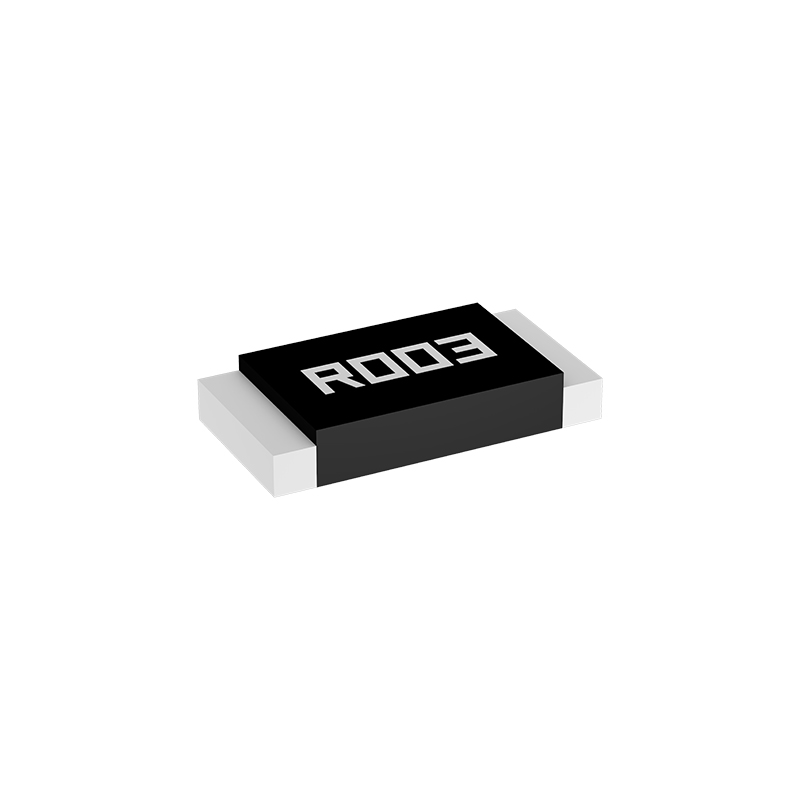
Manganin foil and wire hold their resistivity nearly constant across a wide temperature band, which is exactly what a shunt needs when ambient heat climbs or self-heating kicks in. Copper drifts several percent per hundred degrees, but manganin shifts only a fraction of that, so the voltage drop across the shunt tracks current rather than temperature swings.
The low thermal EMF against copper also matters. In a shunt assembly, junctions between the resistance element and copper terminals can generate small voltages when one side runs hotter than the other. Manganin's Seebeck coefficient stays close to copper's, minimizing that offset and keeping the measured millivolt signal clean. That combination of flat resistance and low parasitic voltage is why high-current sensing circuits often rely on manganin shunts even inside hot enclosures.
Constantan Alloys Cut Thermal EMF in Precision Analog Front Ends
In precision analog front ends, even microvolt-level offsets can swamp signals from sensors. Constantan, a copper-nickel alloy, offers a practical route to suppress those unwanted thermoelectric voltages because its Seebeck coefficient against copper is exceptionally small. When junctions between PCB traces, connectors, and component leads inevitably form, pairing copper with constantan keeps the net EMF near zero across temperature gradients.
Designers often overlook the fact that solder joints and relay contacts introduce tiny thermocouples. Replacing ordinary nickel-iron or tin-lead interfaces with constantan-based connections changes the EMF signature from tens of microvolts per degree to fractions of a microvolt. This becomes critical in 24-bit ADC front ends or low-drift instrumentation amplifiers, where thermal tails would otherwise appear as slow baseline wander.
Field experience shows that symmetrical layout alone cannot cancel gradient-driven offsets if the materials themselves are mismatched. Constantan wire for input leads, carefully matched constantan-copper lugs, and controlled soldering profiles work together to keep thermal EMF below the noise floor of modern analog chains. The result is a quieter front end that holds calibration longer in environments with uneven airflow or nearby heat sources.
Bulk Metal Foil Resistors Deliver Long-Term Stability
Instead of relying on thin-film deposition or wire winding, bulk metal foil resistors start with a cold-rolled foil of a proprietary nickel-chromium alloy, several micrometers thick. This foil is bonded to a ceramic substrate and then etched into a resistive pattern. The key to long-term stability lies in the material's low strain sensitivity and the manufacturer's ability to trim resistance without inducing micro-cracks or thermal shocks. Because the entire resistive element is a single homogeneous layer, there are no grain boundaries or interface stresses that commonly plague other resistor technologies over time.
Over thousands of hours of operation, even under temperature cycling and power loading, bulk metal foil resistors exhibit drift measured in parts per million rather than percent. Their temperature coefficient of resistance can be as tight as ±0.2 ppm/°C, and load-life stability often stays within ±0.005% after 10,000 hours. This is not achieved through aging or burn-in tricks but through the intrinsic mechanical and chemical inertness of the foil. A precision instrument calibrated once can maintain its accuracy for a decade, eliminating the need for periodic recalibration.
Such stability makes these resistors the first choice in reference standards, precision voltage dividers, and metrology-grade analog front ends. Unlike thin-film parts that may show visible drift after a single thermal shock, bulk metal foil devices absorb stress without permanent resistance change. Their predictable behavior allows circuit designers to treat them as truly passive components, not as sources of hidden error in high-resolution data acquisition systems.
High-Power Alloy Resistors and the Art of Thermal Management
When current pushes through a low-ohm alloy element, the heat doesn't spread out politely—it concentrates in a footprint that can be smaller than a grain of rice. With high-power designs pulling tens of amps, the resulting thermal density often rivals what you'd measure on a switching transistor. Managing that heat is not just about keeping the resistance value from drifting; it's about protecting solder joints, nearby passives, and the long-term mechanical integrity of the board itself. Alloy resistors may look rugged, but their performance lives and dies by how well the surrounding copper pulls energy away from the hot spot.
The choice of alloy—manganese-copper, nickel-chrome, or a proprietary blend—sets the baseline for temperature coefficient and thermal EMF, but it's the layout that decides whether those numbers survive contact with reality. A wide, uninterrupted copper pour under each terminal does more for heat spreading than any exotic material swap. Thermal vias drilled in a tight grid beneath the resistor body give the heat a vertical escape route into inner planes or a backside heatsink. Placement matters just as much: putting a 2 W alloy resistor in a dead-air corner next to a tall electrolytic will cook it slowly, no matter how impressive the datasheet curve looks.
The real art comes in validating what happens after assembly. Datasheet power ratings assume a nearly ideal thermal environment that seldom exists in a dense product. Measuring the actual hot-spot temperature under worst-case load often reveals that a component running at 60% of its advertised rating is already pushing past a sensible limit. Infrared imaging or a thermocouple placed close to the element gives a reality check that no simulation can fully replace. From there, the fixes are practical: derate further, split the dissipation across two parallel parts, or add a small copper heat spreader as a deliberate thermal mass. High-power alloy resistors reward engineers who treat heat as a design input, not an afterthought.
Why Alloy Choice Changes Resistor Matching in Differential Pairs
Resistor matching in differential pairs rarely fails because two resistors were drawn at slightly different widths. It fails because the alloy itself sets the scale of local sheet-resistance wander, and that wander is not uniform across alloys. Nichrome and tantalum nitride, for instance, share a nominal low temperature coefficient, but their grain growth during deposition and anneal produces very different spatial frequency in resistance variation. A fine-grained sputtered film may average out over a 10 µm resistor body, while a coarser evaporated film can hold a single large crystallite that tilts the pair by several tenths of a percent.
The practical effect shows up most clearly when a matched pair is laid out as two long stripes. With an aluminum-copper alloy the dominant drift is interfacial, not bulk, so matching degrades as the contact geometry changes. With a silicon-chromium alloy the drift tends to be thermal and nearly reversible, which masks true mismatch until the part cools unevenly. Choosing an alloy therefore changes not just the absolute tolerance, but where the mismatch lives: in the film, at the terminations, or in the thermal history of the trim. A differential pair trimmed to 0.02% in one alloy can easily open to 0.1% in another even when the nominal TCR and sheet resistance look identical on the datasheet.
FAQ
Alloy resistors excel when their temperature coefficient of resistivity is low and their thermal EMF against copper stays minimal. Manganin and Evanohm are classic choices because they drift less than 10 ppm/°C under normal operating conditions, and their stable lattice structure keeps noise down. You also want a bulk metal element rather than a thin film to avoid hot spots and localized stress.
For pulsed loads, bulk metal foil resistors with a nichrome or Evanohm element tend to survive better because they spread heat evenly across the entire resistive path. Thin-film versions can develop microcracks at grain boundaries after repeated thermal cycling. A good rule is to check the pulse energy rating from the datasheet and not just the average power.
Manganin has a near-zero temperature coefficient around room temperature (often within ±5 ppm/°C), making it ideal for metrology-grade shunts. Constantan has a higher thermal EMF against copper, which introduces offset voltages in DC measurements, so it is rarely used for precision low-level sensing. However, constantan is cheaper and easier to process, which is why it appears in many general-purpose current shunts.
Evanohm (a nickel-chromium-aluminum alloy) can operate at higher temperatures than manganin because its oxidation resistance is stronger, and its temperature coefficient stays flat up to about 150°C. Manganin starts to lose stability above 60–80°C in some formulations. The trade-off is that Evanohm is harder to weld and trim, so designers often accept manganin for low-temperature lab work and switch to Evanohm for field instruments.
Nichrome is not usually the first pick for RF because its resistance per square is high and it can add parasitic inductance if wound. But as a thin-film planar element on a ceramic substrate, it provides excellent long-term stability and low capacitance. It works well in termination pads and attenuators where the signal levels are moderate and you need predictable impedance over a wide bandwidth.
Yes, metal foil resistors use a bulk alloy layer (often a nickel-chromium alloy) bonded to a ceramic substrate, and they outperform wirewound parts in terms of non-inductive behavior and low capacitance. Wirewound resistors can suffer from loop inductance that degrades pulse response, whereas foil resistors have a planar current path. Foil also offers sub-ppm/°C tracking when properly matched, which is critical for differential amplifiers.
Look for a resistor with low excess noise, which means avoiding thick-film cermet and focusing on bulk metal alloys. Manganin and Evanohm have very low flicker noise because of their homogeneous structure. Also, match the resistor value to the source impedance to keep thermal noise (4kTR) dominant. In ultra-low-noise designs, the resistor's own thermal EMF can be as troublesome as its noise, so copper-nickel alloys with low Seebeck coefficients are preferred.
Precision alloy resistors are typically formed from a self-supporting metal strip or a bonded foil, giving them a thermal coefficient of resistance below 5 ppm/°C and load-life stability better than 0.01% over 2000 hours. Standard thick-film chips use a ruthenium-oxide paste with a glass matrix, which drifts far more under humidity and power cycling. For any circuit where the gain or offset must remain within a few ppm over years, alloy resistors are the only practical choice.
Conclusion
High-performance circuits rarely succeed on a single resistor type. Nichrome thin film parts earn their place in low-noise, high-gain stages because the deposited layer is uniform enough to keep excess noise from degrading small signals. When current sensing has to stay accurate as temperatures climb, manganin shunts are the quiet workhorses: their near-zero temperature coefficient against copper and low thermal EMF mean the readout does not drift simply because the board heated up. Constantan alloys solve a different problem in precision analog front ends by cutting parasitic thermoelectric voltages at junctions, which is often the difference between a stable microvolt measurement and a wandering offset. For references and feedback networks that must hold their value over years, bulk metal foil resistors outperform typical film parts thanks to a stress-relieved monolithic element that does not creep or shift after soldering or thermal cycling.
Thermal behavior also separates ordinary designs from robust ones. High-power alloy resistors can tolerate heavy dissipation only if the package and PCB layout pull heat away efficiently; otherwise the resistance change under load feeds back into circuit error. Alloy selection even influences how well differential pairs stay matched. Two resistors with different temperature coefficients or self-heating profiles will drift apart and eat into common-mode rejection. Pairing identical alloy types and placing them on the same thermal island keeps that drift manageable. Ultimately, the best alloy resistor depends on the failure mode you are avoiding: noise, thermal EMF, long-term drift, or heat-induced mismatch. Choosing deliberately among nichrome, manganin, constantan, and bulk metal foil lets each section of a high-performance circuit operate without fighting its passive components.
Contact Us
Contact Person: Yuying Gao
Email: [email protected]
Tel/WhatsApp: +86 18926013721
Website: https://en.milliohm.net/