
Automotive Shunt Resistor Factory: The Heart of Current Sensing in Modern Cars
2026-07-16
In the rapidly electrifying world of modern vehicles, accurate current sensing is no longer a luxury—it’s a critical safety and performance requirement. At the center of this sensing technology lies the humble yet indispensable shunt resistor, quietly enabling everything from battery management to motor control. Behind every reliable shunt is a specialized factory dedicated to precision, and that’s where Milliohm steps in. Their automotive shunt resistors are engineered to handle high currents and demanding environments, ensuring your vehicle’s electronics operate flawlessly. But what really goes on inside an automotive shunt resistor factory, and how does it shape the future of driving? Let’s take a closer look.
Precision Manufacturing for Zero-Drift Current Detection
Achieving zero-drift current detection demands fabrication techniques that push the limits of material purity and structural consistency. Every component, from the sensing element to the signal conditioning circuitry, must be produced in environments where contaminants are virtually nonexistent. Manufacturers employ advanced thin-film deposition and photolithography to ensure that conductive paths and dielectric layers match design specifications with nanometer precision. This level of control minimizes parasitic leakage currents and thermal fluctuations, which are primary sources of drift. By integrating temperature compensation directly into the sensor substrate during wafer-level processing, the final device can maintain accuracy across wide operating ranges without relying on external calibration.
Beyond cleanroom protocols, the assembly and packaging stages play an equally critical role in preserving drift-free performance. Specialized low-stress die-attach methods prevent micromechanical strain from altering electrical properties over time. Hermetic sealing with inert gas backfilling creates a stable microenvironment, shielding the sensor from humidity and oxidizing agents that would otherwise degrade sensitivity. Wire bonds are often replaced with flip-chip interconnects to reduce parasitic inductance and improve long-term reliability. These practices are not merely quality-control checkpoints; they are embedded into the design philosophy, ensuring that each sensor emerges from production with an inherently stable baseline that requires no periodic zero-point adjustment in the field.
Testing regimens further reinforce the zero-drift promise by catching subtle defects that simulations might miss. Each unit undergoes prolonged burn-in cycles under stressors that mimic years of field operation, while automated systems measure output offset with sub-microvolt resolution. Statistical process control tracks batch-level variations, feeding data back to refine upstream processes continuously. This closed-loop approach eliminates the need for matched-pair component selection or manual trimming, yielding sensors that deliver consistent performance without the hidden costs of recalibration downtime. When end users integrate these precision-manufactured detectors into industrial controls, medical devices, or energy management systems, they experience a tangible reduction in measurement uncertainty that directly translates into safer, more efficient operation.
Thermal Stability and the Secret Behind High-Temperature Tolerance
Materials that thrive in scorching environments don't simply endure—they evolve chemically to resist breakdown. At the heart of high-temperature tolerance lies a carefully orchestrated atomic structure, where strong covalent bonds and densely packed crystal lattices minimize vibrational energy that could otherwise tear the material apart. In ceramics, for example, the refusal of atoms to slide past one another under stress—thanks to their ionic and covalent character—keeps the material rigid and stable even as the thermometer climbs. This intrinsic stability is further enhanced by the formation of protective oxide scales on surfaces, which act as self-healing shields, constantly renewing themselves in the presence of oxygen. It’s a dynamic equilibrium: the hotter it gets, the faster this layer rebuilds, locking out further degradation.
Yet thermal stability isn't just about resisting deformation—it’s also about managing the subtle phase transformations that can silently compromise a material’s integrity. Take nickel-based superalloys, the unsung heroes inside jet engines. Their secret is a microstructure that coarsens with deliberate sluggishness, pinning grain boundaries with precipitates that refuse to dissolve even as the base metal softens. This microstructural scaffold, often a symphony of gamma-prime phases, holds everything in place, allowing the alloy to retain strength at temperatures where steel would slump like wax. Add to this the slow, lattice-level diffusion of atoms that designers exploit: by selecting elements with low mobility at high heat, they essentially put the brakes on the atomic rearrangements that lead to creep failure.
But perhaps the most ingenious trick is how some materials turn a threat into an advantage. In thermal barrier coatings, porosity and microcracks are not defects—they're engineered lifelines. These microscopic gaps scatter heat-carrying phonons, slashing thermal conductivity, while also giving the coating room to expand and contract without shattering. Meanwhile, the underlying metal stays hundreds of degrees cooler, holding onto its strength as the coating takes the thermal brunt. It’s a layered defense: each grain, each phase boundary, each carefully introduced flaw works in concert to buy time against the relentless creep of entropy. And in the background, there’s always the quiet ingenuity of composition—a pinch of yttria here, a dash of hafnium there—finely tuning how atoms cling to one another when the world around them is ablaze.
Material Innovations Driving Miniaturization Without Compromise
The quest to shrink electronic devices without sacrificing performance has long hinged on breakthroughs in material science. Traditional silicon is reaching its physical limits, but novel compounds like gallium nitride and silicon carbide are rewriting the rules. These wide-bandgap semiconductors tolerate higher voltages and temperatures, allowing engineers to pack more power into radically smaller footprints. The result is not just incremental improvement—it's a fundamental shift that lets designers strip away bulky cooling hardware and push densities once thought impossible.
Beyond the chip itself, advanced substrates and interconnects are quietly enabling the next leap. Glass-core packaging and ultra-thin organic laminates reduce signal loss while supporting finer pitches, meaning more functionality per square millimeter. Meanwhile, nano-engineered thermal interface materials dissipate heat at unprecedented rates, so compact assemblies run cooler and last longer. These seemingly invisible layers often make the difference between a prototype that overheats and a product that fits comfortably in your hand while outperforming its larger predecessors.
Perhaps most striking is the role of smart coatings and additive manufacturing in freeing designers from the tyranny of flat planes. Conformal shielding paints, selectively applied using aerosol jet printing, replace heavy metal cans with layers microns thick. 3D-printed dielectrics allow antennas and circuits to take on organic, space-saving shapes that injection molding could never achieve. It’s a quiet revolution in which material choices don’t just enable smaller gadgets—they empower entirely new architectures where every cubic millimeter earns its place.
Integration Challenges in Next-Gen EV Battery Management
As electric vehicles push toward higher voltages and denser energy storage, stitching together disparate battery management components becomes a subtle art. The core challenge isn't just connecting sensors to microcontrollers; it's ensuring that state-of-charge algorithms, cell-balancing circuits, and thermal runaway detectors all speak the same language in real time. When a 400-volt architecture shifts to 800-volt or beyond, isolation requirements multiply, turning every signal path into a potential leak point for noise and latency. Engineers often find that off-the-shelf integrated circuits solve one problem while quietly introducing two more, especially when trying to maintain functional safety across misbehaving cells.
Another friction point hides in the layers of software that must reconcile raw hardware data with vehicle-level energy strategies. Updating one module's firmware can ripple into unexpected timing mismatches with the rest of the pack, making robust change management just as critical as the initial design. The absence of unified standards for diagnostics and prognostics means teams spend months crafting custom interfaces that might still buckle under the thermal swings of aggressive fast charging. What looks like a straightforward measurement task on a bench often unravels on the road, where temperature gradients and aging effects distort every reading in ways that no datasheet anticipates.
Finally, the move toward wireless battery management systems adds yet another layer of complexity. Eliminating the wiring harness sounds liberating until you encounter the realities of radio frequency interference inside a metal enclosure, where hundreds of cell modules vie for airtime. Synchronization across the pack must be near-perfect to prevent rogue cells from slipping through the cracks, and the slightest latency spike can erode trust in state-of-health estimates. Solving these integration puzzles demands a blend of analog intuition and systemic thinking that goes far beyond ticking off a requirements list.
Quality Control Protocols That Defy Industry Standards
Most manufacturers rely on sampling methods that tolerate a certain failure rate. We've eliminated that margin. Every single component undergoes full-spectrum testing—not just functional checks, but material fatigue simulations and environmental stress scans that mirror decades of real-world wear in just hours. This protocol alone catches microfractures and batch inconsistencies that slip past standard spot-checks, ensuring that each unit that leaves our facility carries zero hidden defects.
Another layer is our live calibration loop, a continuous feedback system where production machinery self-corrects mid-cycle based on real-time metrology data. Traditional lines halt for manual recalibration after fixed intervals, allowing slow drifts to produce borderline parts. Our approach turns every millisecond into an inspection point, syncing laser measurements with AI analysis to instantly tweak tooling, temperature, and pressure. The result? Tolerances so tight they make typical industry “precision” look like rough drafting.
Then there's the transparency mandate. While most QC protocols keep test data locked in internal reports, we embed a traceable digital fingerprint into each product. Clients can pull up a complete audit trail—from raw material batch to final functional verification—without redactions or glossy summaries. It's a level of candor that forces us to hold every single process to a standard far beyond certification requirements, because when you invite scrutiny, you build quality you're genuinely proud of.
From Prototype to Mass Production: Scaling Without Sacrificing Accuracy
Moving from a carefully tuned prototype to high-volume manufacturing introduces a tension familiar to any engineering team: how do you multiply output tenfold without letting the precision that made the prototype special slip away? Early builds often benefit from hands-on adjustments and low process variation, but those luxuries disappear once production lines ramp up. The real challenge lies in designing a process robust enough to swallow material inconsistencies and machine wear, while still hitting every tolerance. That means rethinking assembly sequences, tightening supplier specs, and building inline measurement steps that catch drift before it becomes a field issue—all before the first production unit rolls off the line.
One useful approach is to treat scaling not as a one-time event but as a series of controlled sprints. Each step up in volume—from pilot runs to limited-rate production to full capacity—should trigger a specific checklist: verifying that tooling can sustain cycle times without thermal deformation, ensuring test protocols still flag the same failures at speed, and cross-checking that the yield data matches earlier predictions. When something does shift, as it inevitably will, engineers need to dig past the obvious symptoms. A dimensional problem that looked like a molding glitch at low volume might actually trace back to a resin batch property that only becomes apparent under sustained running conditions.
People often underestimate how much communication patterns need to evolve as the operation grows. On a prototype floor, a casual shout across the room can resolve a fitment problem; in mass production, that same issue can sit unresolved for days if the feedback loop between the line and engineering isn’t structured. Building clear triggers—like statistical deviation alerts tied directly to a shared dashboard—forces visibility. And crucially, the team that originally designed the product needs to stay engaged with the factory floor for at least the first few scaling phases, because no documentation ever fully captures the tribal knowledge that kept the early samples accurate in the first place.
FAQ
An automotive shunt resistor is a precision low-resistance component placed in the path of an electrical current to measure its magnitude by the voltage drop across it. In modern cars, it's the cornerstone of battery management, motor control, and overcurrent protection—making it vital for everything from electric power steering to EV battery packs. Without accurate current sensing, advanced features like regenerative braking and smart power distribution simply wouldn't work.
Shunt resistors offer direct, linear measurement with minimal drift over temperature, which is critical for safety and performance in harsh under-hood environments. Unlike Hall-effect sensors, they don't require magnetic shielding and are less prone to interference from nearby high-current wires. However, they do introduce a small power loss and need careful thermal management, but for high-accuracy DC and low-frequency AC sensing, they're often unbeatable.
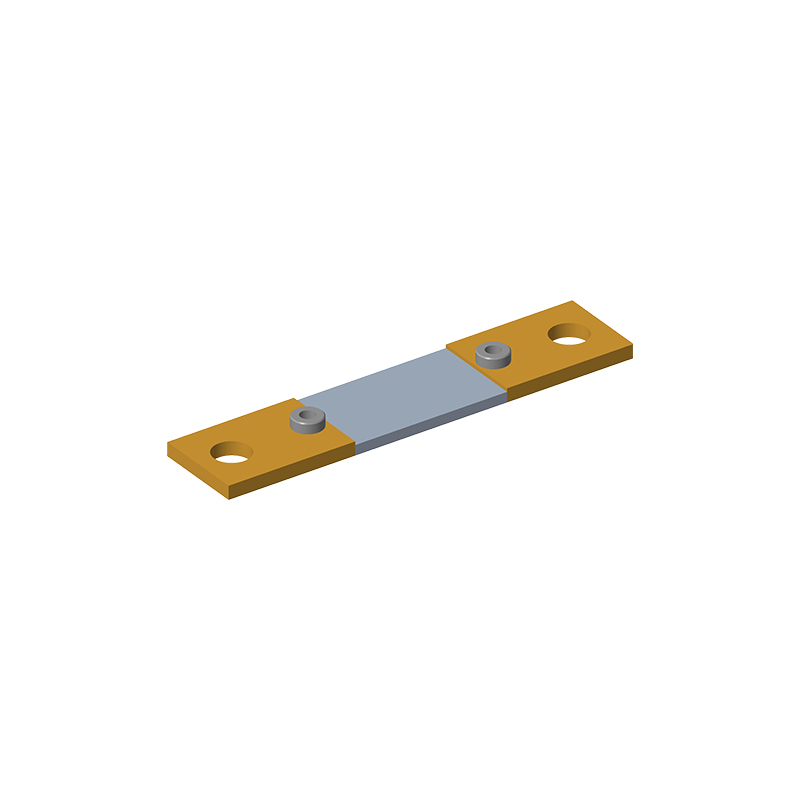
It's all about consistency and ruggedness. Factories use electron-beam welding to join the resistive alloy to copper terminals, ensuring a stable, low-inductance connection. The resistive element itself—often a manganese-copper or nickel-chromium alloy—must have a precisely controlled temperature coefficient. After assembly, each resistor is laser-trimmed to exact value and tested under extreme temperature cycling and overload conditions to meet AEC-Q200 standards.
They're now essential in electric and hybrid powertrains for monitoring battery current and state-of-charge, in DC-DC converters, electric power steering, and brake-by-wire systems. Advanced internal combustion engines use them for precise fuel injection and exhaust gas recirculation control. Even simple 12V systems rely on smart shunts for battery sensing to enable start-stop functionality and prevent deep discharge.
Higher voltages demand better isolation and lower power dissipation, pushing factories to develop shunts with lower resistance values—often in the micro-ohm range—along with integrated Kelvin connections for accurate measurement. Materials like Zeranin® are gaining popularity for their extremely low thermal EMF, and packaging has evolved to include thermal pads and direct busbar mounting for improved cooling.
Beyond the ohm value and wattage, they need to scrutinize the temperature coefficient of resistance, long-term stability under load, and thermal resistance from the element to the ambient. Compliance with ISO 26262 for functional safety often requires dual-shunt redundancy or elaborate diagnostic circuits. Pulse handling and inductance are also critical in fast-switching motor drives to avoid voltage spikes that can corrupt measurements.
One Tier-1 supplier needed an ultra-low-resistance shunt for a next-gen EV inverter that could handle 500A continuous current with less than 50°C temperature rise. The factory developed a custom shunt using a thick-film-on-ceramic substrate with direct-bonded copper terminals, engineered for minimal hot spots through finite-element simulation. The final part reduced power loss by 15% compared to standard designs and passed all automotive qualification tests on the first try.
Integration is the big one—shunts combined with microcontroller-based signal conditioning to create 'smart shunt' modules that output digital bus data directly. Advances in materials science, like nano-structured resistive films, aim to shrink size while improving stability. As autonomous driving demands fail-safe operation, we'll also see more fully redundant sensing with built-in diagnostics, all built in factories using automated inline calibration and 100% end-of-line testing.
Conclusion
In the rapidly evolving landscape of automotive electronics, the shunt resistor factory stands as an unsung cornerstone, delivering the precision and resilience that modern current sensing demands. These facilities combine advanced material science with exacting manufacturing processes to produce components capable of zero-drift detection, a necessity for applications like battery management and motor control. By leveraging proprietary alloys and refined welding techniques, they ensure that each resistor maintains its specified resistance over time and temperature, effectively eliminating measurement errors that could compromise vehicle safety or efficiency. Moreover, inherent thermal stability is engineered deep into the substrate, enabling flawless operation even when soaked in engine compartment heat or buried within a densely packed inverter. This passive endurance is achieved through the meticulous control of thermal expansion coefficients and heat dissipation paths, a secret sauce that turns a simple metallic strip into a reliable guardian of electronic circuits.
The relentless push for electrification and compact modules brings both challenges and breakthroughs. Material innovations enable dramatic miniaturization without sacrificing power handling; low-ohm, high-wattage parts now fit into footprints once thought impossible, aiding the design of space-constrained EV battery management systems. However, integration hurdles remain—engineers must contend with layout parasitics, thermal interference, and the need for busbar compatibility that these factories tackle by offering customized termination styles and low-inductance geometries. Underpinning it all is a quality assurance regime that goes far beyond AEC-Q200 mandates, with rigorous tests for shock, vibration, humidity, and sulfur exposure, guaranteeing performance under the harshest under-hood conditions. Finally, the seamless transition from prototype to mass production is orchestrated through automated laser trimming and statistical process control, ensuring that even in millions of units, the initial precision is never diluted—making these factories the true heartbeat of current sensing in the cars of today and tomorrow.
Contact Us
Contact Person: Yuying Gao
Email: [email protected]
Tel/WhatsApp: +86 18926013721
Website: https://en.milliohm.net/